Predictive analytics tools for business growth

Ever feel like you’re making million-dollar decisions with nickel-and-dime information? You’re not alone. While your instincts got you this far, the business landscape has evolved beyond what gut feelings alone can navigate.
The game-changer? Predictive analytics tools for business growth that transform raw data into rocket fuel for your expansion plans.
Table of Contents
What Are Predictive Analytics Tools for Business Growth?
Not crystal balls or magic tricks, but sophisticated technology that spots patterns invisible to the human eye and forecasts outcomes with startling accuracy.
Predictive analytics tools for business growth are software platforms and systems that analyze your historical data to forecast future events, behaviors, and trends. They’re like having a team of data scientists working 24/7 to answer your most pressing business questions before you even ask them.
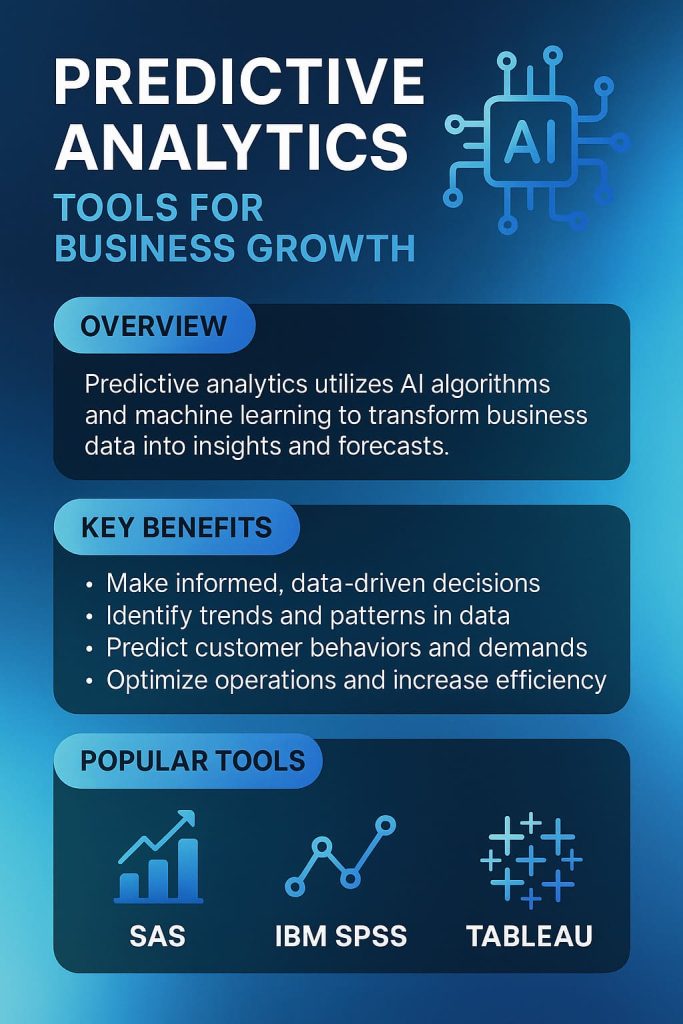
These tools combine statistical algorithms, machine learning techniques, and AI to process massive amounts of information. Customer purchase histories, market trends, operational metrics, social media sentiment—everything becomes ammunition for better predictions.
The beauty lies in their versatility. Some platforms specialize in customer analytics, helping you understand buying behaviors and predict churn. Others focus on operational optimization, forecasting demand and identifying bottlenecks before they strangle your productivity. The best predictive analytics tools for business growth offer modular capabilities that scale with your needs.
Modern platforms have evolved beyond requiring PhD-level expertise. No-code and low-code solutions now put powerful predictive capabilities in the hands of business analysts and department heads. You don’t need to understand the mathematics behind gradient boosting or neural networks. You just need to know which questions matter for your business and let the predictive analytics tools for business growth do the heavy lifting.
Predictive Analytics Tools for Business Growth: From Owning the Tools to Realizing the Growth
Share of all businesses at each stage of depth, from intent to adopt through to integration that changes how work is done. Each stage is a subset of the one above it, so the funnel narrows as the commitment deepens.
- Businesses using predictive and AI tools or expecting to adopt them within six months22%
- Businesses actively using these tools in at least one business function18%
- Businesses running them across more than three business functions8%
- Businesses where the tools do more than assist individual tasks6%
Why the funnel narrows, and where growth is created: the tools are no longer the constraint, because access is cheap and interfaces no longer require specialist skills. Depth is the constraint. Adoption climbs sharply with company size, reaching 32 percent on an employment weighted basis, and large employer surveys place use in at least one function near nine in ten organizations. Yet the population that has pushed prediction across several functions remains a narrow minority, and deployment of autonomous agents stays in the single digits in almost every function. Measurable growth tracks the breadth and depth of integration, not the purchase of a license.
Sources: Source 1, Source 2. Source 1 is a nationally representative government survey of business technology use. Stages three and four apply the reported depth of integration among adopting businesses to the overall business use rate, so both are shown as approximate values.
Why Are Predictive Analytics Tools for Business Growth Important?
Money talks, and predictive analytics tools for business growth speak fluently in revenue and profit.
By the time you manually analyze last month’s data and draft a strategy, market conditions have already shifted. Predictive analytics tools for business growth compress weeks of analysis into hours or even minutes. This velocity allows you to capitalize on opportunities while they’re fresh and pivot away from threats before they become crises.
Consider the cascading effects of improved forecasting. When you accurately predict demand, you optimize inventory levels—reducing carrying costs while eliminating stockouts. When you anticipate customer needs, you personalize offerings that drive loyalty and lifetime value. When you foresee market shifts, you reallocate resources before competitors recognize that change is happening. Each win compounds into a sustainable competitive advantage.
The risk mitigation alone justifies the investment. Predictive analytics tools for business growth help you spot trouble brewing in your supply chain, identify customers likely to churn, detect fraud patterns, and anticipate equipment failures. These aren’t hypothetical benefits—they’re documented outcomes that protect your bottom line while freeing resources for growth initiatives.
These tools democratize data-driven decision-making across your organization. Sales, marketing, operations, finance—every department gains access to predictive insights relevant to their challenges. This creates a unified culture where decisions flow from evidence rather than opinions or office politics.
How Do Predictive Analytics Tools Solve Growth Challenges?
These platforms attack growth challenges from multiple angles simultaneously. Marketing teams use them to identify high-value prospects and predict campaign effectiveness before spending a dollar. Sales organizations forecast deal closures with unprecedented accuracy, allowing better pipeline management and resource allocation.
The integration capabilities of modern predictive analytics tools for business growth eliminate data silos that traditionally hamper decision-making. Customer information from your CRM, financial data from ERP systems, operational metrics from production software—everything flows into unified models that reveal relationships and patterns invisible when data lives in separate systems.
Real-time processing transforms how you respond to changing conditions. Imagine adjusting pricing dynamically based on demand predictions, inventory levels, and competitor moves. Or shifting marketing spend between channels as predictive models identify emerging opportunities.
Predictive Analytics Tools for Business Growth: Where Adoption Stands and Where It Is Heading
Each bubble is an industry. The horizontal position shows the share of businesses using these tools today, the vertical position shows the share expecting to use them within six months, and the bubble size shows how large that expected increase is. Every bubble sits above the diagonal, which marks no change.
- 1Information39.7% to 42.0%
- 2Professional, scientific and technical services38% to 41%
- 3Finance and insurance33.9% to 39.0%
- 4All businesses, national benchmark19.8% to 22.0%
- 5Retail trade14% to 17%
- 6Manufacturing12% to 18%
Bubble size is proportional to the expected increase in percentage points, from roughly two points in the most saturated industry to roughly six points in the fastest moving one.
Two clusters, one lesson for growth: the industries at the upper right have already made these tools standard equipment, so the edge available from simply owning them is thinning. The industries at the lower left carry the widest expected increases, which means the advantage there is still unclaimed but closing fast. Company size compounds the effect, because roughly 37 percent of businesses with at least 250 employees already use these tools against under 20 percent of businesses with four or fewer. For a smaller company in a lagging industry, predictive analytics represents ground that larger competitors have already taken and immediate rivals have not.
Sources: Source 1, Source 2, Source 3. Source 1 is a nationally representative government business survey and supplies the exact figures for information, finance and insurance, retail trade and the national benchmark. Source 2 supplies the expected six month increases for the remaining industries. Values shown without a decimal are approximate readings of the underlying survey.
How to Select the Right Market Research Partner
Choosing a partner for predictive analytics tools for business growth resembles selecting a surgeon for a complex operation.
Start by evaluating industry expertise. Generic analytics firms might understand the technology, but do they grasp the nuances of your market? Healthcare faces different challenges than retail. Manufacturing operates under different constraints than financial services. Your ideal partner brings deep experience with predictive analytics tools for business growth specifically tailored to your industry’s unique requirements.
Technical capabilities vary wildly across providers. Some excel at customer analytics but struggle with operational forecasting. Others specialize in risk modeling but lack marketing analytics depth. Assess your priority use cases and ensure your partner demonstrates proven expertise in those specific applications of predictive analytics tools for business growth.
Support structures determine long-term success. Initial implementation is just the beginning. As your business evolves, your predictive models need updating. As users encounter questions, they need responsive assistance. As new opportunities emerge, you need guidance on expanding capabilities.
How Predictive Analytics Tools Investments Pay for Themselves

Let me tell you about a regional telecommunications provider wrestling with customer retention. Their churn rate hovered around 18% annually, and traditional retention campaigns felt like throwing darts blindfolded. Each lost customer represented roughly $1,200 in annual revenue, making the bleeding substantial.
They implemented predictive analytics tools for business growth, focused specifically on churn prediction. The system analyzed usage patterns, customer service interactions, billing history, and competitor activities to identify at-risk customers with 89% accuracy. More importantly, it identified the specific factors driving each customer’s dissatisfaction, enabling targeted retention strategies.
Within the first quarter, churn dropped to 14.2%—a 21% reduction. Applied across their 180,000 customer base, this translated to 6,840 fewer defections annually. At $1,200 per customer, that’s $8.2 million in protected revenue against an initial investment of $380,000 in predictive analytics tools for business growth. The payback period? Less than three weeks.
But the story doesn’t end with retention. Marketing used the same tools to identify high-value prospects, increasing conversion rates by 34%. Customer service leveraged predictive insights to anticipate issues before customers called, boosting satisfaction scores by 19%. The initial investment in predictive analytics tools for business growth created cascading value across multiple departments.
Note: While this story is based on real strategies we’ve employed, specific client details have been tweaked to respect confidentiality.
What Are the Opportunities and Challenges?
New markets become accessible when you can accurately forecast demand and customer preferences in unfamiliar territories. Product development accelerates when you predict which features will resonate and which will flop. Strategic partnerships become more fruitful when you identify ideal collaborators before competitors spot the opportunity.
However, challenges loom large for unprepared organizations.
Data quality issues torpedo even the most sophisticated predictive analytics tools for business growth. Incomplete records, inconsistent formats, missing values, duplicate entries. These problems corrupt predictions and erode trust in the entire system.
Skills shortages present another significant hurdle. Demand for data scientists, machine learning engineers, and analytics professionals far exceeds supply. Salaries have skyrocketed, and talent competition is fierce.
Change resistance often proves more difficult than technical implementation. People who’ve succeeded using intuition and experience resist new approaches, especially when algorithms challenge their judgment. Successfully deploying predictive analytics tools for business growth requires as much focus on change management as technology selection.
Future of Predictive Analytics Tools for Business Growth Case Study
AI integration is pushing prediction accuracy to levels that seemed impossible recently. A manufacturing client recently deployed AI-enhanced predictive maintenance tools that forecast equipment failures with 96% accuracy up to two weeks in advance. This capability reduced unplanned downtime by 68% and extended equipment life by 23%.
Democratization continues to accelerate as no-code platforms make sophisticated capabilities accessible to non-technical users. We’re seeing marketing managers build customer lifetime value models, operations directors create demand forecasting systems, and HR leaders develop turnover prediction tools… All without writing a single line of code.
What Makes SIS AI Solutions the Best Choice for Your Company?
Four Decades of Strategic Intelligence Experience
SIS AI Solutions brings over 40 years of market research and strategic consulting expertise to every engagement, combining time-tested methodologies with cutting-edge predictive analytics tools for business growth. This unique perspective ensures your analytics initiatives connect directly to strategic business objectives rather than becoming isolated technical projects.
Industry-Specific Expertise Across Key Sectors
With dedicated practice areas in Healthcare, FinTech, B2B, and Consumer markets, SIS AI Solutions delivers predictive analytics tools for business growth tailored to your industry’s specific challenges and opportunities. This specialization means you’re working with consultants who understand both the technology and the unique dynamics of your market.
Comprehensive End-to-End Implementation Support
Unlike vendors that deliver software and disappear, SIS AI Solutions provides comprehensive support throughout the entire journey. This partnership approach ensures predictive analytics tools for business growth deliver sustained value rather than becoming expensive shelfware.
Custom AI and Machine Learning Development
SIS AI Solutions develops custom algorithms and predictive models specifically designed for your unique business challenges, rather than forcing you into one-size-fits-all solutions. It ensures predictive analytics tools for business growth address your specific needs with precision that generic platforms can’t match.
Proven Track Record of Measurable Business Impact
SIS AI Solutions focuses relentlessly on business outcomes rather than technical sophistication for its own sake. Every implementation of predictive analytics tools for business growth is designed to deliver measurable improvements in revenue, cost efficiency, customer satisfaction, or other key performance indicators that matter to your bottom line.
Frequently Asked Questions
What’s the difference between predictive analytics tools and business intelligence platforms?
Business intelligence platforms show you what happened: sales reports, performance dashboards, historical trends. They’re excellent for understanding past performance but limited when planning future strategy. Predictive analytics tools for business growth flip this script by forecasting what’s likely to happen next and why.
How much technical expertise do I need to use predictive analytics tools?
Modern predictive analytics tools for business growth have evolved significantly in terms ofthat enable you to accessibility. Many platforms now offer no-code or low-code interfaces where you can build and deploy models using visual workflows rather than programming. If your team can use Excel or basic BI tools, they can likely learn to use contemporary predictive platforms.
Can predictive analytics tools work with limited historical data?
Data requirements vary depending on what you’re trying to predict and the techniques employed. Generally, you’ll want at least 18-24 months of historical data for reliable patterns to emerge. However, some predictive analytics tools for business growth can supplement limited internal data with external sources—market trends, economic indicators, industry benchmarks—to improve accuracy.
How do I measure ROI from predictive analytics tools?
ROI measurement should align with the specific business problems you’re solving. If you’re using predictive analytics tools for business growth to reduce churn, track retention rates and calculate revenue protected. For demand forecasting, measure inventory carrying costs and stockout reductions. For marketing optimization, monitor customer acquisition costs and conversion rate improvements.
What happens if my predictions are consistently wrong?
Prediction errors are valuable learning opportunities that reveal gaps in your data, models, or understanding of the business. When predictive analytics tools for business growth produce inaccurate forecasts, systematically analyze why. Was the data incomplete? Did external factors not captured in the model affect outcomes? Did business conditions change in unexpected ways?
How long does it take to implement predictive analytics tools?
Implementation timelines vary dramatically based on data readiness, organizational complexity, and project scope. Simple deployments with clean data and focused use cases might show initial results in 4-8 weeks. Complex enterprise-wide implementations can take 6-12 months or longer.
Do predictive analytics tools replace human decision-makers?
Absolutely not. Predictive analytics tools for business growth augment human judgment rather than replacing it. They process vast amounts of data faster than humans can and identify patterns we’d likely miss, but they lack context, intuition, and the ability to consider factors outside their training data.
Our Facility Location in New York
11 E 22nd Street, Floor 2, New York, NY 10010 T: +1(212) 505-6805
About SIS AI Solutions
SIS AI Solutions is where four decades of Fortune 500 market intelligence meets the power of AI. Our subscription-based platform transforms how the world’s smartest companies monitor markets, track competitors, and predict opportunities—delivering monthly dashboards and real-time competitive intelligence that turns market uncertainty into strategic advantage.
Ready to outpace your competition? Get started with SIS AI Solutions and discover how AI-powered market intelligence can accelerate your next moves.